Why Granny Flats Matter Now
Australia’s housing supply remains under pressure, with rising construction costs and limited land availability in established suburbs. As a result, secondary dwellings are increasingly recognised as a practical and scalable solution.
Research indicates that hundreds of thousands of existing suburban lots could accommodate a granny flat, highlighting the real potential of backyard densification. This approach allows new housing to be delivered without the need for large-scale rezoning or infrastructure expansion.
Recent state and local policy changes, including faster approvals, clearer guidelines, and selective council fee waivers, have further improved feasibility. These shifts make granny flats more attractive for homeowners looking to house family members, generate rental income, or downsize while staying on their existing property.
Granny Flat Market Trends of 2025 — What to Watch For in 2026
- Booming search and buyer interest: Search data and property reports point to strong growth in interest across cities such as Sydney, Perth, and Adelaide. Homeowners are increasingly exploring granny flat options for aging parents, multi-generational living, and supplementary rental income.
- Faster, prefab-led delivery: Off-site prefabrication and modular construction continue to gain momentum. These systems offer shorter build times, more predictable pricing, and reduced exposure to labour shortages. A major advantage compared to traditional construction methods.
- Policy support and local incentives: Councils across Australia are trialing lower application fees, streamlined approvals, and clearer rules around renting secondary dwellings. These changes reduce uncertainty and make it easier for property owners to proceed with confidence.
- Investment shift: The granny flat investment market is gaining attention as a relatively affordable way to increase rental yield and capital value, particularly in land-constrained inner and middle-ring suburbs. Investors are increasingly viewing granny flats as a flexible asset rather than a compromise build.
Innovative granny flat designs
Design has moved well beyond the basic one-bedroom layout. Today’s innovative granny flat designs focus on adaptability, privacy, and liveability, including:
- Flexible floor plans that can switch between studio, one-bedroom, or home-office configurations to suit different life stages
- Stacked or ‘Fonzie’ flats, built above garages or adjacent to the main dwelling, maximising smaller blocks while improving separation
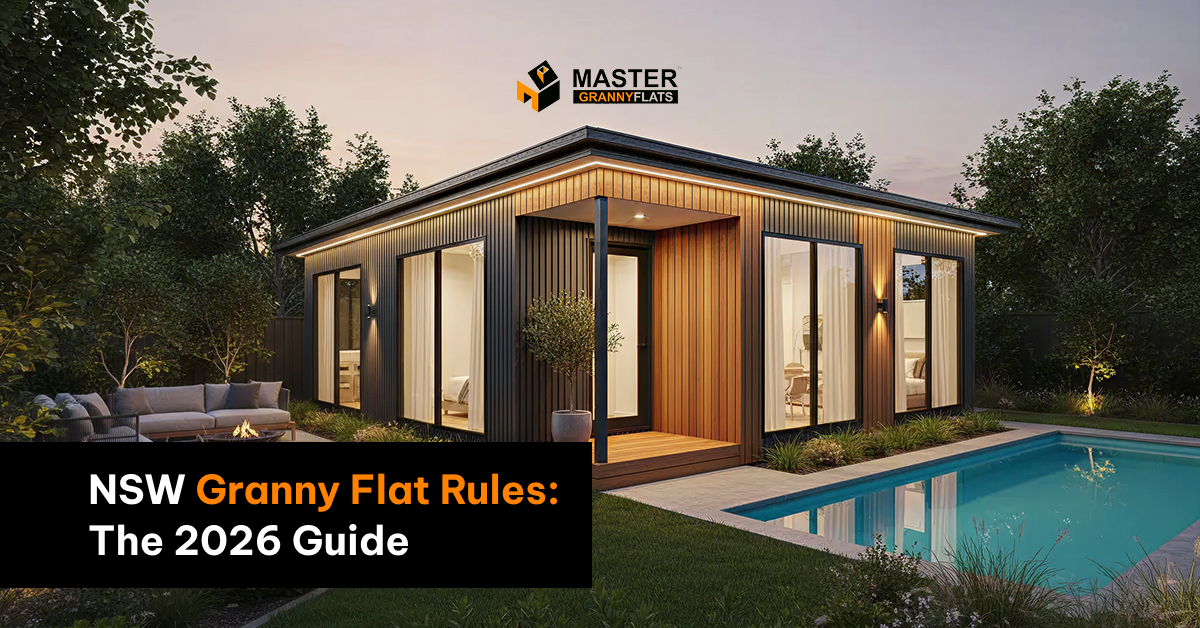
- Architect-designed micro-dwellings featuring premium finishes, smart storage, and high ceilings, blurring the line between granny flats and boutique homes
These design advancements make granny flats more appealing to renters and family members alike, supporting modern lifestyles in compact spaces.
Sustainable granny flats & eco-friendly builds
Sustainability has become a key decision factor rather than a nice-to-have. Sustainable granny flats and eco-friendly granny flat Australia solutions are now mainstream, driven by both cost savings and environmental awareness.
Common features include:
- Passive design principles such as orientation, shading, and cross-ventilation to reduce energy use
- High-performance insulation, glazing, and energy-efficient appliances
- Solar systems, battery storage, and water-saving technologies increasingly offered as standard
- Low-impact materials and off-site construction methods that reduce waste and site disruption
These features improve comfort, reduce running costs, and enhance long-term rental appeal while strengthening asset resilience.
Granny flat technology innovation
Technology is reshaping how granny flats are designed, built, and managed. Key areas of granny flat technology innovation include:
- Smart home integrations for energy monitoring, security, and remote access
- Digital planning tools and 3D visualisations that allow owners to explore layouts and finishes before construction
- Factory-controlled build processes and IoT-enabled maintenance systems that reduce defects and simplify ongoing management
These innovations help create modern, low-maintenance dwellings that appeal to both owner-occupiers and tenants.
Granny flats as an affordable housing solution Australia
Due to their smaller footprint and faster delivery timelines, granny flats are increasingly promoted as an affordable housing solution Australia can implement at scale.
When combined with council incentives and efficient prefab construction, homeowners can add a self-contained dwelling at a significantly lower cost than traditional subdivisions. Rolled out broadly, this model has the potential to contribute meaningful housing supply across established suburbs without altering neighbourhood character.
Is a Granny Flat Worth It?
From a financial perspective, granny flats can be a strong option where:
- Land values are stable and rental demand is consistent
- Local planning rules allow long-term rental use
- Build costs align with achievable rental yields
Market data suggests that a well-designed secondary dwelling can improve cash flow and overall property value. However, outcomes vary by suburb, council regulations, and design quality. Thorough due diligence remains essential, including checking zoning requirements, rental demand, and return on investment.
Final Words
The future of granny flats in Australia is both practical and promising. Planning reforms, modular construction, sustainable design, and growing market demand are transforming granny flats from a niche concept into a mainstream housing solution.
Whether your goal is to support family, generate additional income, or contribute to much-needed housing supply, granny flats in 2025 and beyond offer a flexible, affordable, and environmentally conscious option.
If you’re ready to explore what’s possible on your property, Master Granny Flats can guide you through feasibility, council requirements, and modern design options tailored to your suburb. Get in touch to turn this opportunity into a clear, achievable plan.